
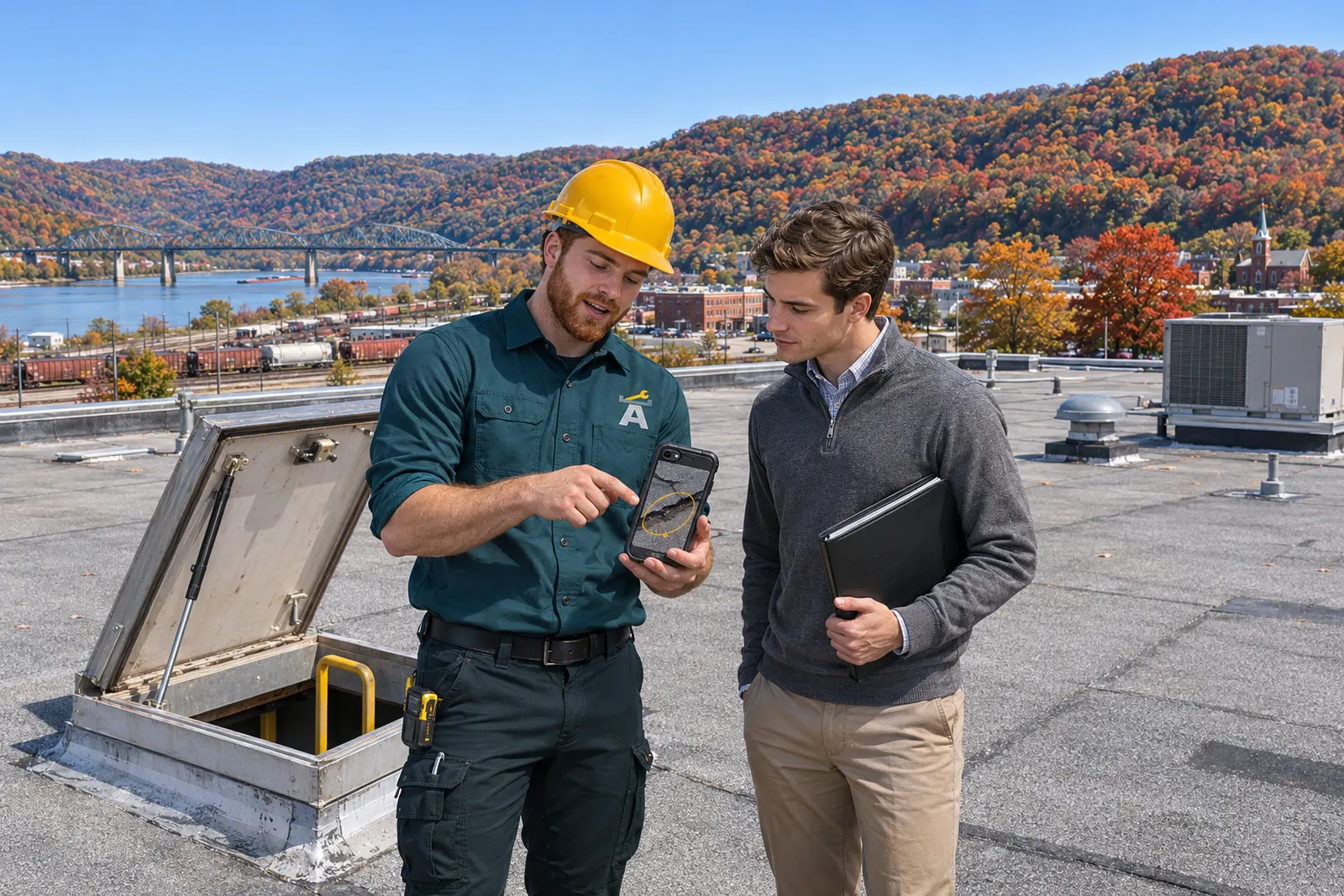
Commercial Roof Repair Questions in Ashland
Plain Answers on Leaks, Seams, Metal Panels, and Local Permits
These are the commercial roof repair questions in Ashland we hear most, answered for flat, metal and plant roofs.
Answers to Commercial Roof Repair Questions in Ashland
Owners send us these commercial roof repair questions in Ashland before almost every job.
Commercial roof repair is fixing leaks and damaged areas on the flat, low-slope and metal roofs of commercial, industrial and agricultural buildings. Ashland Commercial Roof Repair traces leaks and repairs seams, flashing, drains and panels in Ashland and surrounding towns of Boyd County, Kentucky, and the nearby river counties, and tells owners when a section needs more than a patch.
Ashland Commercial Roof Repair Questions on Roof Systems
Commercial Roof Repair Basics
What counts as a commercial roof repair?
A commercial roof repair fixes one failed part of the roof so the rest of the system keeps working. It targets a split seam, a torn flashing, a loose fastener or a clogged drain instead of replacing the whole roof.
Typical repair jobs on Ashland buildings:
- Rewelding or re-taping an open membrane lap
- Patching a puncture next to an RTU curb
- Resealing pitch pans and pipe boots
- Replacing backed-out screws on R-panel steel
- Clearing and resetting a drain clamping ring
- Refastening lifted edge metal after wind
Each fix is matched to the roof material, since TPO, EPDM, modified bitumen and steel all take different patch methods.
When is repair enough, and when does a roof need restoration or replacement?
Repair is enough when damage is limited to specific spots and the insulation under the membrane is dry. Restoration or replacement enters the picture once problems spread across the roof or water has soaked the layers underneath.
| Path | Roof condition | Work involved |
|---|---|---|
| Repair | A few leaks, isolated seam or flashing failures | Patch, reseal, refasten |
| Restore | Aging surface, many small failures, dry insulation | Repairs plus a full coating system |
| Replace | Wet insulation over wide areas, rotted deck, repeated failures | Tear-off and new roof |
A moisture survey or core cut tells which path fits, because wet boards hidden under an intact-looking membrane change the answer.
What is the difference between a temporary and a permanent roof repair?
A temporary repair stops water for now, while a permanent repair rebuilds the failed spot with materials matched to the roof system. Temporary work buys time until weather or materials allow the real fix.
| Factor | Temporary repair | Permanent repair |
|---|---|---|
| Materials | Roof cement, tape, tarps | Matching membrane, primer, welded or adhered patch |
| Surface prep | Wipe and apply | Clean, prime, cut back damaged layers |
| Weather | Done wet or cold | Needs dry surface and workable temperatures |
| Duration | Short term | Part of the roof system |
Mastic smeared over a TPO seam during a storm holds water off for a while. That spot still needs a cleaned, welded patch once the sheet dries. More on commercial roof leak repair.
What should a facility manager check on a commercial roof each season?
Seasonal roof walks catch small failures before they turn into interior leaks. Spring and fall checks, plus a look after any strong storm, cover most Ashland buildings.
Walk the roof and note:
- Drains, scuppers and gutters packed with leaves or debris
- Open seam edges and lifted laps
- Cracked sealant at pitch pans and curbs
- Punctures near RTUs where techs kneel or set tools
- Loose or bent edge metal and coping
- Backed-out screws and rust at panel laps on metal roofs
Take dated photos of each item. Comparing them season to season shows which spots are getting worse.
Flat Roof Repair Questions
How are split seams fixed on a flat commercial roof?
Split seams on a flat roof get cleaned, prepped and closed with a patch matched to the membrane type. The fix starts by finding how far the open lap runs, since the visible gap is often shorter than the failed bond.
Steps for a seam repair:
- Probe along the lap to mark both ends of the opening.
- Scrub dirt and oxidation off the sheet on both sides.
- Reweld TPO or PVC with hot air, or prime and tape EPDM.
- Cover the repaired lap with a cover strip that extends past the opening.
- Recheck the repaired lap with the probe once the patch cools or cures.
Seams near drains and at T-joints fail first because water sits there longest.
What causes blisters on a flat roof, and should they be cut open?
Blisters form when trapped air or moisture between membrane layers expands in the sun and pushes the surface up. They show up most on built-up and modified bitumen roofs, and on adhered single-ply where the bond let go.
How to handle them:
- Small, firm blisters that stay closed get marked and watched.
- Soft or cracked blisters get cut, dried, and patched over.
- Clusters across a roof section point to wet insulation underneath.
- Fresh blisters near a recent leak call for a core cut to check the boards.
Stepping on a blister can crack its skin and let water in, so service paths are routed around them until the repair is done.
Is ponding water on a flat roof a repair problem or a drainage problem?
Ponding is a drainage problem that turns into a repair problem once water sits long enough to find a weak seam or flashing. Many roofs pond because a drain is clogged, set high or surrounded by a sunken deck area.
Repair-level fixes for ponding:
| Cause | Repair approach |
|---|---|
| Clogged drain or strainer | Clear debris, replace broken strainer dome |
| Drain set higher than the roof | Add a tapered sump or retrofit drain insert |
| Sagging insulation around the drain | Replace wet boards and rebuild the slope |
| Water trapped behind an RTU curb | Add a small cricket |
Ponding across large areas needs tapered insulation, which belongs with a recover or replacement rather than a patch.
How is a puncture or tear in a flat roof membrane repaired?
A puncture or tear is repaired by cleaning the area, rounding the patch corners and bonding or welding a patch of matching membrane well past the damage. Cutting back any torn edges first keeps the patch flat.
Common causes on Ashland roofs:
- Dropped tools and screws around RTUs
- Hail strikes on thin or aged sheets
- Foot traffic over rigid conduit or pipes
- Fallen limbs on roofs next to trees
After patching, press on the area around the hole. Soft insulation under a puncture means water got in, and that board gets cut out and replaced before the patch goes on.
Which repair method fits TPO, EPDM, modified bitumen and built-up roofs?
Each flat roof membrane has its own repair method, and mixing them leads to patches that peel off. The material on the roof decides the primer, the patch and the tool.
| Roof type | Repair method | Key detail |
|---|---|---|
| TPO | Hot-air welded patch of new TPO | Clean oxidized sheet before welding |
| PVC | Hot-air welded PVC patch | Avoid contact with asphalt products |
| EPDM | Primer plus peel-and-stick EPDM patch | Roll firmly, round the corners |
| Modified bitumen | Torch, cold adhesive or self-adhered cap patch | Embed granules on exposed patches |
| Built-up (BUR) | Plies of felt and asphalt, then gravel | Remove loose gravel before patching |
An unknown membrane gets a small test cut to identify it before patch materials are ordered. More on flat roof repair in Ashland.
Commercial Metal Roof Repair Questions
Why do screws back out on a metal roof, and how are they fixed?
Daily expansion and contraction of the steel panels slowly works screws loose and wears out their rubber washers. A backed-out screw leaves a gap at the washer that lets water run along the threads.
Fastener repair steps:
- Walk each screw line and mark raised or rusted heads.
- Remove screws with stripped holes.
- Drive oversized replacement screws with new washers.
- Snug screws so the washer seals without flattening.
- Seal heads where the panel shows rust around the hole.
On a large R-panel roof, crews often find whole rows loose along the eaves and ridge, where movement is greatest.
How are leaking side laps and end laps repaired on metal panels?
Leaking laps are repaired by cleaning the overlap, replacing failed sealant or butyl tape and adding stitch screws to pull the panels tight. End laps leak most because water crosses them on its way to the eave.
Common lap failures:
- Missing or dried-out butyl tape at end laps
- Too few stitch screws along side laps
- Panels lifted by wind at the overlap
- Rust bleeding out from inside the lap
After the lap is tightened, a strip of reinforced seam sealer goes over the joint. Laps with rust holes through both panels need a new panel section instead.
Should a rusted metal roof panel be patched or replaced?
Rusted panels with surface rust or small holes can be patched, while panels rusted through over a wide area need replacing. The extent of the rust and the condition of the purlin underneath decide the fix.
| Condition | Usual fix |
|---|---|
| Surface rust, solid steel | Wire brush, prime, seal |
| Pinholes at laps or fasteners | Clean, prime and cover with a sheet metal or fabric patch |
| Rust-through over one panel | Replace that panel |
| Rusted purlins under the panel | Repair the structure, then replace panels |
Gutters and eaves rust first, since water and debris collect there. Check those edges whenever a panel near them is being replaced.
How are gutter and eave leaks fixed on a metal building?
Gutter and eave leaks are fixed by resealing gutter seams, replacing failed eave closures and making sure the panel ends overhang into the gutter. Water that runs behind the gutter usually traces back to a missing closure or a short panel.
What gets checked:
- Gutter end caps and seam joints for split sealant
- Hangers that let the gutter sag and hold water
- Foam closures under the panel ends at the eave
- Downspout outlets clogged with leaves or nests
- Rust holes along the gutter bottom
Ice in winter backs water up under the panel ends when gutters are full, so clearing them before cold weather prevents many eave leaks.
How does metal roof repair differ from membrane roof repair?
Metal roof repair focuses on fasteners, laps and trim, while membrane repair focuses on seams, patches and flashings adhered to a continuous sheet. The tools and materials barely overlap.
| Factor | Metal roof repair | Membrane roof repair |
|---|---|---|
| Common leak points | Screws, end laps, ridge caps, curbs | Seams, flashings, drains, punctures |
| Main materials | Screws, butyl tape, sealant, sheet metal | Matching membrane, primer, seam tape |
| Tools | Screw guns, nibblers, seamers | Hot-air welders, rollers, probes |
| Surface prep | Wire brush rust, clean oil | Scrub oxidation, prime |
| Movement | Panels expand with heat | Membrane flexes with deck |
Buildings with both, such as a metal plant with a flat office addition, need a crew comfortable on each system. More on metal roof repair.
Commercial Roof Leak Repair Questions
How do you find where a commercial roof leak is coming from?
Leak tracing starts inside at the stain, then moves to the roof directly above and upslope to find where water gets in. Water travels along deck flutes, insulation joints and purlins before it drips, so the entry point is often several feet away.
Tracing steps:
- Mark the interior stain and measure it to a wall or column.
- Find the same spot on the roof.
- Check every curb, pipe, seam and drain upslope from it.
- Probe seams and inspect flashing terminations.
- Water test suspect areas one at a time, starting downslope.
Testing one spot at a time avoids confusing two leaks with one.
Where do commercial roof leaks start on different roof types?
Leaks start at different spots depending on the roof system, because each one has its own weak points.
| Roof type | First places to check |
|---|---|
| TPO or PVC | Seam welds, corners, curb flashing, drain clamps |
| EPDM | Seam tape, T-joints, pipe boots, edge cover tape |
| Modified bitumen | Lap edges, blisters, base flashing at walls |
| Built-up | Bare spots in gravel, cracks at flashings |
| Standing seam metal | Seam end caps, ridge closures, curbs |
| R-panel metal | Screw washers, end laps, skylight panels |
Parapet walls deserve a look on every type. Cracked coping joints and open masonry let water into the wall, and it shows up inside as a roof leak.
Why do RTU curbs, pitch pans and skylights leak so often?
RTU curbs, pitch pans and skylights leak often because they cut through the roof and depend on flashing and sealant that wear out sooner than the membrane. Vibration and service traffic add stress at the same spots.
Common failures:
- Curb flashing pulled loose by vibration from the unit
- Pitch pan sealer shrunk away from the support it surrounds
- Skylight frames with cracked gaskets or failed curb flashing
- Missing cricket on the upslope side of a large curb
- Condensate lines dripping onto the roof and wearing the surface
Pitch pans get refilled with fresh sealer. Curbs with loose flashing get stripped and reflashed with matching membrane.
Can condensation look like a roof leak?
Condensation can look exactly like a roof leak, dripping from the deck or panels on cold mornings even when the roof surface is intact. Warm, moist indoor air meets the cold underside of the roof and turns to water.
Signs it is condensation:
| Clue | Condensation | Roof leak |
|---|---|---|
| Timing | Cold mornings, without rain | During or after rain |
| Pattern | Spread across many spots | Tied to one area |
| Location | Under bare steel or near wet processes | Under seams, curbs, drains |
Metal shops with open panels and buildings with wash-down areas see this most. The fix is insulation and ventilation, while a roof patch changes nothing.
When does a commercial roof leak need a temporary fix before the permanent repair?
A temporary fix comes first when water is entering during rain or cold weather and the permanent repair needs a dry, warm surface. Stopping the water protects stock, equipment and ceilings while waiting for workable conditions.
Temporary steps:
- Roof cement and reinforcing fabric over a split seam
- Tape over an open lap on a metal roof
- Tarp over a large damaged area, weighted at the edges
- Buckets and plastic inside under active drips
Mark each temporary spot on a roof plan with the date. Permanent repair follows once the forecast clears.
Question About Your Own Roof?
Every roof is a little different. Tell us the roof type and where the water shows up, and we will answer it on the roof.
Ashland Commercial Roof Repair Questions on Permits, Cost and Towns
Industrial Roof Repair Questions
How is roof repair handled on an operating plant?
Plant roof repairs are scheduled around production, with crews working on the outside while operations run underneath. Coordination with plant maintenance keeps work safe and avoids shutting down lines.
Plan for:
- Hot work permits for torches or welders near process areas
- RTU and exhaust fan shutdowns during curb repairs
- Air intake locations, so adhesive odors stay out of the building
- Material lifts that keep loading docks open
- Safety rails or warning lines along roof edges and openings
Repairs over sensitive equipment get plastic and drip pans underneath before any cutting starts.
What damage do exhaust fans and process vents cause on industrial roofs?
Exhaust fans and process vents drop grease, oil and chemical residue that soften, swell or crack some membranes. The damage spreads out from the fan in a ring.
What to look for:
- Soft, sticky or swollen membrane around kitchen or process fans
- Discolored or blistered areas downwind of vents
- Clogged drains from grease buildup
- Cracked sealant at the fan curb
Repair means cutting out the damaged membrane and replacing it with a sheet rated for that exposure, such as PVC near grease. Adding a grease containment box at the fan keeps the new patch from failing the same way.
How do you repair large areas of wet insulation on an industrial roof?
Large wet areas are repaired by cutting out the membrane and soaked insulation, replacing them with dry boards and new membrane, and tying the section into the existing roof. Wet boards left in place keep rotting the deck and feeding leaks.
The process:
- Map wet areas with infrared or a moisture meter grid.
- Confirm with core cuts at the edges of each area.
- Remove membrane, insulation and cover board down to the deck.
- Inspect steel flutes for rust and plate where needed.
- Install new boards and membrane, then weld or tape the tie-in.
When wet areas cover a large share of the roof, replacement costs less over time than repeated sections. More on industrial roof repair.
What causes repeated punctures and wear on industrial roofs?
Repeated punctures on industrial roofs come from foot traffic, dropped tools, sharp debris and equipment resting on the membrane. Busy service routes between hatches and RTUs wear down the sheet first.
Ways to cut down on punctures:
| Source | Repair and prevention |
|---|---|
| Service traffic | Walk pads along regular routes |
| Pipes and conduit on the sheet | Pipe supports to lift them |
| Screws and metal scraps from HVAC work | Roof sweep after each service visit |
| Hail | Thicker patches and cover board in replacement areas |
| Equipment legs on the membrane | Pads or flashed curbs under each leg |
Tracking where punctures show up each year points to the routes that need walk pads.
What should be checked on a large industrial roof after a storm?
After a strong storm, a large industrial roof needs a walk focused on edges, corners, rooftop equipment and drains, since wind and hail hit those first.
Storm check list:
- Edge metal and coping lifted or bent
- Membrane torn or billowing at corners
- RTU panels, hoods and exhaust caps shifted or open
- Hail marks on membrane, metal panels and skylight frames
- Drains and scuppers blocked by debris
Photograph damage with dates and locations. Insurance claims and repair priorities both rely on that record, and edge damage gets fixed first so the next wind does not peel the roof back further.
Weather, Permits and Codes in Ashland
Does a commercial roof repair need a permit in Ashland and nearby towns?
The local office decides which roof repairs need a permit, and patch work at seams and flashings is the lightest scope to describe. Call before larger work such as deck replacement, structural repairs or swapping out a whole roof section.
| Where the building sits | Office to ask |
|---|---|
| Inside Ashland or Catlettsburg | The one local inspector the state's Boyd sheet names for both |
| Unincorporated Boyd County (Westwood, Cannonsburg) | The county's office for commercial permits |
| Greenup County cities (Russell, Flatwoods, Raceland, Greenup, South Shore, Worthington, Wurtland) | City hall first, the county judge-executive's office next |
| Grayson | DHBC, or the Carter County local inspector |
| Olive Hill or Louisa | DHBC, the state office |
Describe the repair by size and materials so the office can classify it.
How do freeze-thaw cycles and humid summers cause roof leaks around Ashland?
Freeze-thaw cycles and humid summers both stress roof seams, flashing and fasteners in the Ashland area. Water that gets into a small crack freezes overnight, widens the gap, and lets more water in on the next thaw.
Seasonal effects:
| Season | What happens on the roof |
|---|---|
| Winter | Ice expands cracks in sealant and opens laps |
| Spring | Storms test flashing and clogged drains |
| Summer | Heat expands panels and loosens screws |
| Fall | Leaves block gutters and scuppers |
Most patches need dry conditions, so repair schedules shift around rain and cold mornings.
What should be checked after a severe storm warning in the Ashland area?
After a severe thunderstorm warning from the National Weather Service in Charleston, West Virginia, owners should walk or photograph the roof within a few days. That office issues warnings for Boyd, Greenup and Carter counties.
Check for:
- Hail dents in metal panels, gutters and RTU housings
- Fractured skylight domes or cracked panels
- Loose edge metal, coping and gutter straps
- Membrane tears at corners and perimeter
- Debris in drains and scuppers
Fresh damage is easier to document for insurance. Temporary covers go on damaged spots before the next rain.
When does a repair cross into work the building code treats as reroofing?
A repair becomes reroofing when it replaces or recovers a large area of the roof rather than fixing individual spots. The Kentucky Building Code, which DHBC lists as the 2018 edition based on the 2015 International Building Code, covers reroofing requirements.
Signs the scope has grown:
- Removing and replacing the membrane over a whole roof section
- Replacing insulation and deck across a wide area
- Adding a new roof layer over the old one
- Changing the roof slope or drainage
Ask the local office how it classifies the job before the work grows beyond patches and flashings.
Cost, Value and Taxes
What affects the cost of a commercial roof repair?
The cost of a commercial roof repair depends on how hard the leak is to find, the roof material, the size of the damaged area and access to the roof. A single open seam costs far less to fix than wet insulation spreading under a whole bay.
Cost drivers:
- Time spent tracing hidden leaks
- Roof type and matching materials needed
- Wet insulation or deck that must be replaced
- Number of curbs, pipes and skylights involved
- Lifts, ladders or hoists needed to reach the roof
- After-hours work to avoid disrupting operations
Spotting and fixing small problems early keeps repair bills smaller.
When does it stop making sense to keep repairing a commercial roof?
Repairs stop making sense when leaks keep appearing in new spots, wet insulation spreads, or the membrane is brittle across the roof. At that point, money spent on patches goes into a roof that keeps failing.
Signs to weigh:
| Sign | What it suggests |
|---|---|
| New leaks every season | Widespread aging |
| Wet insulation over many areas | Restoration or replacement |
| Brittle, cracked membrane | Patches will not bond well |
| Rusted-through metal panels in many spots | Panel replacement or new roof |
A roof survey with core cuts shows whether a restoration coating or a replacement fits the roof better.
Do commercial roof repairs qualify for Section 179?
Section 179 covers roofs as qualified improvements on existing nonresidential buildings, so the answer depends on whether the work counts as a repair or an improvement. IRS Publication 946 lists roofs among the property that can qualify when placed in service after the building.
For tax years starting in 2026, the deduction limit is $2,560,000, reduced dollar for dollar once qualifying purchases pass $4,090,000.
Keep invoices that describe the scope plainly: patching seams, replacing panels, or tearing off and replacing a roof section. Your CPA decides which treatment applies.
Questions by Town
Who should an Ashland owner call about a repair inside city limits?
Inside Ashland city limits, the local building inspector listed on the state's Boyd County contact sheet handles questions about roof work. Boyd County has no county building inspector, per that sheet.
Call the city before repairs that include:
- Replacing a section of steel deck under a leak
- Rebuilding a parapet wall or coping
- Moving or adding RTU curbs
- Swapping membrane and insulation across a whole bay
Patch-level fixes at seams, pitch pans and drains are the simplest scope to describe. Buildings with Ashland mailing addresses outside city limits go to the Boyd County office.
Why do roofs inside the Ashland floodwall overflow during heavy rain?
Roofs inside the floodwall overflow when drains, scuppers or downspouts are clogged and storm water backs up behind parapets. The city's Floodwall Division runs six pump stations and maintains over three miles of concrete wall plus earthen levees on the west end.
Repairs that help:
- Clearing drain strainers and replacing broken domes
- Opening or enlarging overflow scuppers
- Resealing leaking downspout connections
- Rebuilding sunken areas around interior drains
Water trapped behind a parapet can find a cracked coping joint or loose base flashing quickly, so drainage repairs come before seam work.
How does wind off the Ohio River damage roofs in Russell?
Wind crossing the Ohio River hits Russell roofs at corners and edges, lifting edge metal and membrane where fastening is weakest. Once a corner lifts, wind gets under the sheet and peels it further with each storm.
Repairs on exposed Russell roofs:
- Refasten or replace lifted drip edge and gravel stop.
- Reattach coping caps with new cleats.
- Patch membrane torn at corners and perimeter seams.
- Add fasteners in corner zones of attached systems.
Building questions there start at Russell's city hall, according to the Greenup County sheet.
Who handles roof repair questions in Flatwoods?
Flatwoods building questions go to the city office, as the Greenup County contact sheet directs for cities in that county. Simple repairs rarely touch zoning, but adding equipment or changing roof height can.
When to ask the city:
| Repair work | Why ask |
|---|---|
| Patching seams, pipe boots, pitch pans | Confirm no permit needed |
| Replacing an RTU and its curb | Rooftop equipment changes |
| Rebuilding a canopy roof | Structural work |
| Adding retrofit framing | Height and zoning |
Flatwoods keeps zoning information on its city website, so check there when repair work changes the building's look.
Why does early morning dew delay roof repairs in Catlettsburg?
Catlettsburg sits where the Big Sandy River joins the Ohio, and the humid air leaves heavy dew on roofs most mornings. Patch adhesives, primers and hot-air welds need a dry surface to bond.
How crews work around it:
- Start repairs once the membrane is dry to the touch
- Dry the patch area with a torch or blower where safe
- Use temporary covers on active leaks until conditions allow
- Watch for condensation that mimics leaks inside buildings
Catlettsburg and Ashland share the same local building inspector on the Boyd County contact sheet.
What should Raceland owners check on their roofs after hail?
Raceland owners should check panels, gutters, skylights and membrane surfaces for hail damage within a few days of a storm. NWS Charleston covers Greenup County and issues severe thunderstorm warnings that mention hail size.
Hail damage signs:
| Roof part | What hail leaves |
|---|---|
| Metal panels | Round dents, chipped paint |
| Membrane | Bruises, cracks, exposed scrim |
| Skylights | Cracked or shattered panels |
| RTUs | Dented fins and housings |
| Gutters | Dents that hold water |
Document damage with dated photos before repairs start. Raceland's building questions go to the city office, per the Greenup County contact sheet.
Why do farm and shop metal roofs near Greenup rust faster?
Metal roofs near Greenup rust faster where valley moisture along the Ohio and Little Sandy rivers keeps panels damp for long stretches. Damp steel wears out washers, starts rust at laps and corrodes gutters.
Repair priorities:
- Replace rusted screws and dried washers.
- Clean, prime and seal rust at end laps.
- Swap panels rusted through at the eaves.
- Clear gutters packed with debris that holds water.
Greenup is the county seat, and the Greenup County sheet lists a local building inspector and a state inspector. Inside city limits, start with the city office.
Who supplies power for RTU shutdowns during roof repairs in Grayson?
Grayson buildings are served by Grayson Rural Electric Cooperative or Kentucky Power, so check the electric bill before planning RTU shutdowns. Both list Carter County in their service areas.
Repairs that need power off at the unit:
- Reflashing a leaking RTU curb
- Replacing curb gaskets and screws
- Repairing condensate line damage on the roof
For permits, the Carter County contact sheet sends commercial construction to DHBC and lists a local building inspector who covers Grayson. Ask which office handles curb replacement.
Where do Olive Hill owners go for structural roof repair permits?
Olive Hill owners take structural roof repair questions to the Kentucky Department of Housing, Buildings and Construction. The inspector named for Carter County on the state sheet covers Grayson and the county, yet leaves Olive Hill out.
Structural repairs include:
- Replacing rusted steel deck under leaks
- Repairing sagging purlins on metal roofs
- Rebuilding parapet walls or roof edges
Simpler patches at seams, laps and fasteners are smaller in scope. Ask the state office and Olive Hill city hall how they classify the repair.
Do South Shore roof repairs follow Kentucky or Ohio rules?
South Shore roof repairs follow Kentucky rules, even though Portsmouth, Ohio, is just across the river. Crews or suppliers coming from Ohio need to work under the Kentucky Building Code for a South Shore building.
What applies:
| Item | South Shore requirement |
|---|---|
| Building code | Kentucky Building Code |
| Permit office | South Shore city hall, or the county judge-executive's office |
| Inspector | Greenup County local or state inspector |
Low-slope sections near the river collect debris in drains after storms, so drain clearing is a common repair there.
How does an owner confirm which office covers a Worthington roof repair?
An owner confirms the office by looking up whether the parcel falls within Worthington's boundary, which runs right next to Raceland. The Kentucky Atlas and Gazetteer notes Worthington includes land once in Raceland and the Melrose community, and it was incorporated in 1920.
Steps:
- Check the tax bill or Greenup County PVA record.
- Call Worthington city hall if inside city limits.
- Describe the repair: seam patches, panel replacement or deck work.
Small fixes at seams and flashings are simpler to describe than deck or panel replacement.
What should Louisa building owners know before a roof repair?
Louisa owners should know that Lawrence County has no local building inspector, so commercial work goes through the Kentucky Department of Housing, Buildings and Construction. Electric service comes from Kentucky Power, Big Sandy Rural Electric or Grayson Rural Electric.
Before a repair:
- Check the electric bill for the provider
- Plan RTU shutdowns for curb work
- Ask DHBC how it classifies deck or panel replacement
- Clear drains and gutters before patching nearby seams
Louisa sits on the Big Sandy River, and damp mornings there delay patch work until roof surfaces dry.
Which smaller communities around Ashland get roof repair service?
Repair service also reaches three smaller communities around Ashland, split between two counties.
| Community | County | Where to ask about permits |
|---|---|---|
| Wurtland | Greenup | Wurtland city hall, then the county judge-executive's office |
| Westwood | Boyd | Boyd County's commercial permit office |
| Cannonsburg | Boyd | Boyd County's commercial permit office |
Westwood and Cannonsburg are unincorporated, so roof work goes through Boyd County even when mail reads Ashland. Wurtland is a Greenup County city along the Ohio River.
Getting Started
How do I get a commercial roof leak looked at in Ashland?
Start by noting where and when the leak shows up inside, then schedule a roof inspection that traces it to the source on the roof. The inspection looks at seams, flashings, curbs, drains and fasteners near the leak.
Have ready:
- Photos of interior stains with dates
- Weather conditions when the leak appeared
- Roof access location and any keys or codes
- RTU service contacts
- Past repair records
The inspection shows whether a patch, a larger section repair or a replacement fits the roof.
What information helps a roof repair crew work faster?
Roof drawings, leak history and building hours help a repair crew plan the work and find problems quickly. Knowing the roof type and age also tells the crew which materials to bring.
Useful details:
| Information | How it helps |
|---|---|
| Roof type and age | Matches repair materials |
| Leak history | Points to recurring problem spots |
| Building hours | Sets work times |
| Sensitive areas inside | Plans protection under repairs |
Clear access to the roof hatch or ladder saves time on the first visit.
Still Have Commercial Roof Repair Questions in Ashland?
Call or ask for an inspection. We will answer it standing on your roof.