
Which Office Approves Bigger Work
Ashland and Catlettsburg share a local inspector, Greenup County cities start at city hall, and Olive Hill and Louisa go to DHBC for structural roof work.
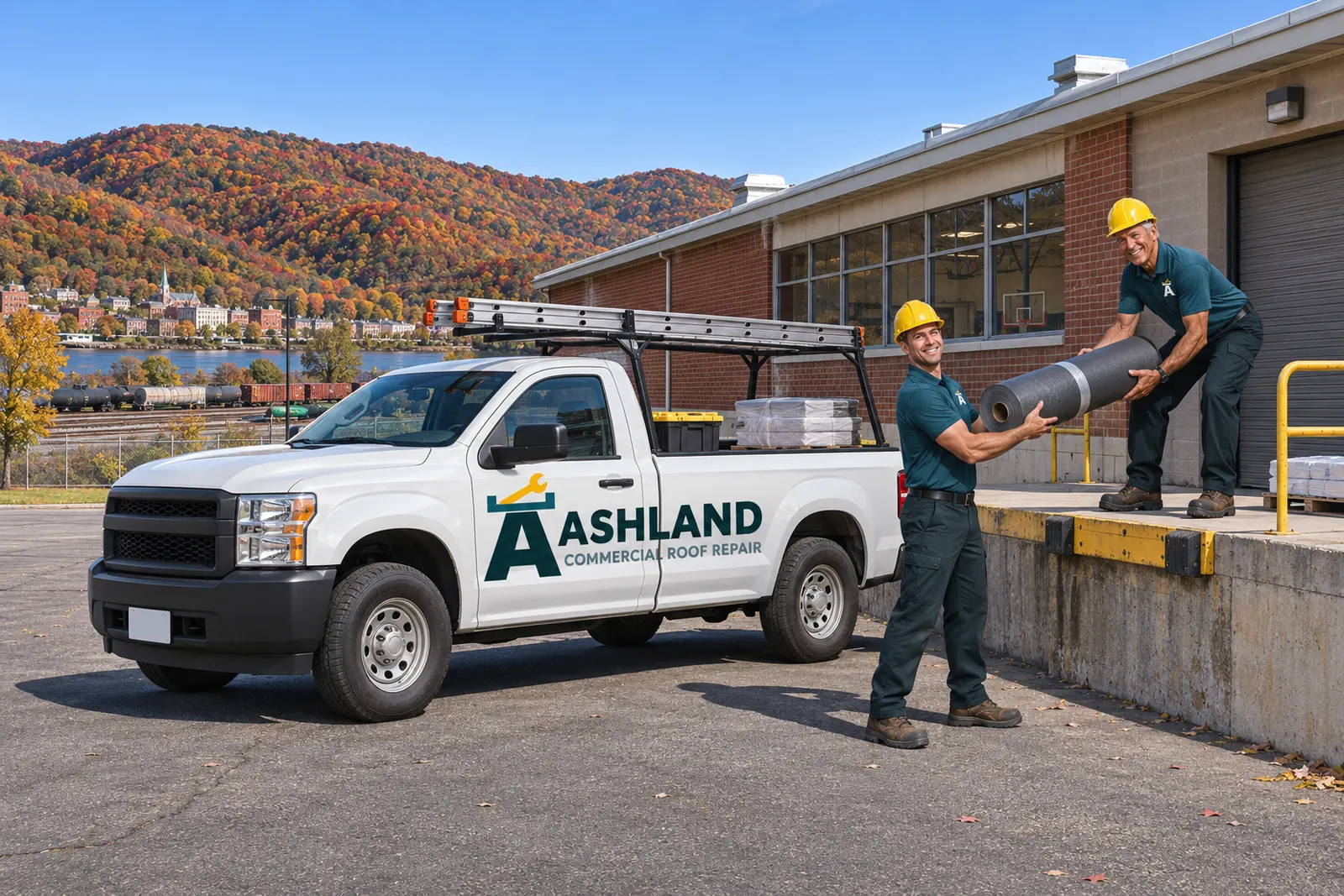
We handle commercial roof repair near Ashland in ten towns with their own pages and three more we serve from the same visits.
For commercial roof repair near Ashland outside these towns, call us or send us a message. Each county below sends roof questions to a different office.
Inside city limits, roof questions go to the local building inspector the state lists for Boyd County. Flat roofs behind the floodwall need clear drains and scuppers before seam work starts.
Catlettsburg shares Ashland's local building inspector on the state's Boyd County sheet. Heavy morning dew at the Big Sandy and Ohio confluence sets when patch work can begin.
Exposed roofs along the river take wind at corners and perimeter seams first. Building questions start at Russell city hall, as the Greenup County sheet directs.
Seam and pipe-boot patches rarely involve the city, but a new rooftop unit or a rebuilt canopy can. Flatwoods posts its zoning information on the city website.
Hail leaves round dents in steel, bruises in membrane and cracks in skylights. Dated photos taken soon after the storm keep repair priorities and claims straight.
Valley moisture keeps steel panels damp, so screws, washers and end laps rust sooner. As the county seat, Greenup has both a local and a state inspector listed.
Ohio suppliers working here follow the Kentucky Building Code. Drains on low-slope sections near the river collect debris after storms and need clearing before seam repairs.
Worthington takes in land once part of Raceland plus the Melrose community. A tax bill or PVA record settles which city hall handles the repair.
Grayson buildings get power from Kentucky Power or Grayson Rural Electric. The Carter County sheet sends commercial construction to DHBC and names a local inspector who covers Grayson.
The Carter County inspector on the state sheet leaves Olive Hill out, so structural roof questions go to DHBC. Seam and fastener patches are the lighter scope.
Commercial work in Louisa goes through DHBC. Damp mornings on the Big Sandy push patch work later in the day, and drains get cleared before nearby seams.
Tell us the address and what the roof is doing. If it is close to the towns we cover, we can usually fit the inspection into the same route.
The repair methods stay the same everywhere. These local details change the order of work and who to call first.
Ashland and Catlettsburg share a local inspector, Greenup County cities start at city hall, and Olive Hill and Louisa go to DHBC for structural roof work.
Towns on the Ohio and Big Sandy see damp roofs most mornings, so primers and welds wait for a dry membrane.
Buildings facing the river take wind at corners first, which loosens edge metal and coping before field seams.
Grayson and Louisa are served by different electric providers, which matters when a rooftop unit has to shut down.
Who to call about larger repairs depends on where the building sits.
Patch work at seams and flashings is the lightest scope to describe, but the local office decides. Inside Ashland or Catlettsburg, ask the shared local inspector. Westwood and Cannonsburg go to Boyd County's commercial permit office.
Greenup County cities start at city hall, then the judge-executive's office. Grayson goes to DHBC or the Carter County inspector, while Olive Hill and Louisa go to DHBC.
Wurtland, Westwood and Cannonsburg. Wurtland is a Greenup County city on the Ohio River, so roof questions start at its city hall.
Westwood and Cannonsburg are unincorporated, so permits run through Boyd County even when the mail reads Ashland.
We cover the ten towns with pages here plus Wurtland, Westwood and Cannonsburg. For a plant or warehouse just past those lines, call with the address and roof type and we will tell you plainly whether the job fits our route.
Send the address and a photo of the stain or the roof. We will confirm the town and set up the inspection.